
The heavens declare the glory of God; the skies proclaim the work of his hands … I praise you because I am fearfully and wonderfully made. — David in Psalm 19:1 and Psalm 139:13
Origins
(By the way, I almost removed this page recently while reworking and trimming this site. But I had so much fun writing it several years ago, I couldn’t bring myself to do it. Hope you enjoy it …)
Most people look at the entire question of Origins the wrong way. They think that if there’s no need for a Creator to explain our existence, there’s no point in believing in God at all.
(It’s a new show called, “Revenge Of The God Of The Gaps.” The ratings aren’t in yet.)
That’s sad, because God wants you to enjoy and understand His creation … and He also wants to know you personally. Every one of us is born with a hole in our heart that only God can fill.
I’m going to show you that there is strong evidence for design in this Cosmos, but first, let’s see where we’re at now and how we got here.
Complexity != Design
This is my first chance to be pedantic; I shall jump on it. (You have been warned.) There seems to be some confusion about what a “design” argument is. Many skeptics think that we Believers are victims of (to use Richard Dawkin’s phrase) “Personal Incredulity:” we see complexity and order all around us and surrender to the idea of a Designer.
Poor widdle small-minded peoples, we just can’t help ourselves!
But actually, a true design argument has little to do with complexity or organization. Crystals, for example, can be quite beautifully detailed, but they’re just a simple molecular sequence that repeats, over and over.
(Perhaps they’re the Cosmos’ way of ordering a misbehaving mineral to write “I will not be a shapeless blob” on the chalkboard a zillion times).
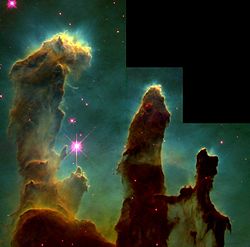
Nature is also filled with examples of complex, chaotic systems that show little intelligence: the weather, Congress* and stellar nebulae, just to name a few.
An Example
Reach into your pocket and pull out a coin. Here in America, I’ll choose a good ol’ dime — a 10 cent piece. Examine that fellow for a nice long moment. Flip it over. Look at both sides. That’s not a complicated structure by any means. It’s just a slug of metal that has been stamped with the image of a dead US President.
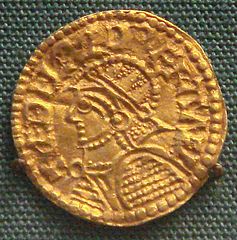
Coins have been around for thousands of years. The image below is a gold mancus from the reign of Aethelred the Unready, king of England c. 1000AD. Historians think he must have minted these early on, because he spent most of his later years screaming and running from the (superbly named) Sweyn Forkbeard.
Ours are prettier than the Romans’ or Babylonians’ because we have better machines and quality control now, but the basic idea has been the same for as long as there have been coins.
Now: you wouldn’t look at that and think that a natural process forged it, would you? As simple as it is, it shows obvious evidence of design. Someone, or something, created that coin from base ingredients.
Responses
The first response to a design argument has been called an Appeal To Present Ignorance. “People used to think that an eclipse was a giant dragon eating the sun. Give us time to study this and we’ll come up with a rational answer.”
That’s a valid objection. But may I point out that you are demonstrating faith in that future knowledge? You don’t have it in your hands at this moment. Now, you can certainly argue that your faith is justified: science has done a great job thus far, and so on. But it’s still faith.
That’s a philosophical argument that could keep us amused for days; I’d rather move on to the second response, which has been called an Appeal To Many Chances. If this universe is extremely old and large (the majority viewpoint prior to Big Bang cosmology), or if this universe is just one of zillions, each with its own set of physical laws, then it’s a moot point.
The cosmos would appear to be designed, but of course it would, or we wouldn’t be here to wonder about it, would we?

God Is Dead … ?
By the end of the 19th century, Darwin had provided a framework that would account for the diversity of life on this planet. The origin of life itself was still open to question, but an Appeal To Many Chances was provided by astronomy. Scientists knew that the Earth wasn’t infinitely old, but also knew that Earth wasn’t the only planet.
Astronomers had charted a good bit of the cosmos and no matter where they looked or how powerful the instruments, all they saw were stars and more stars.
Hey, the cosmos was huge. It wasn’t hard to believe that at least one planet would “get it right” and produce life.
Once it was believed — quite reasonably, at the time — that the Earth was just one of a thunderin’ bozillion planets and that the universe was very old (and probably infinite in size, to boot!), anything was possible.
Problem solved, let’s do lunch!
Explain This Fine-Tuning Thing!
Not long ago, I was doing some Web searches on “fine tuned cosmos” and the like. One of the top-ranked answers came from a guy who flatly said,” there IS no evidence of fine tuning.” I could only wonder which cave this fellow had been living in for the past 30 years!
Space.com , ScienceDaily.com, and other sites regularly report on fine tuning. They’ll usually state that the very reason why the Multiverse concept has become popular is because it explains the FINE TUNING.
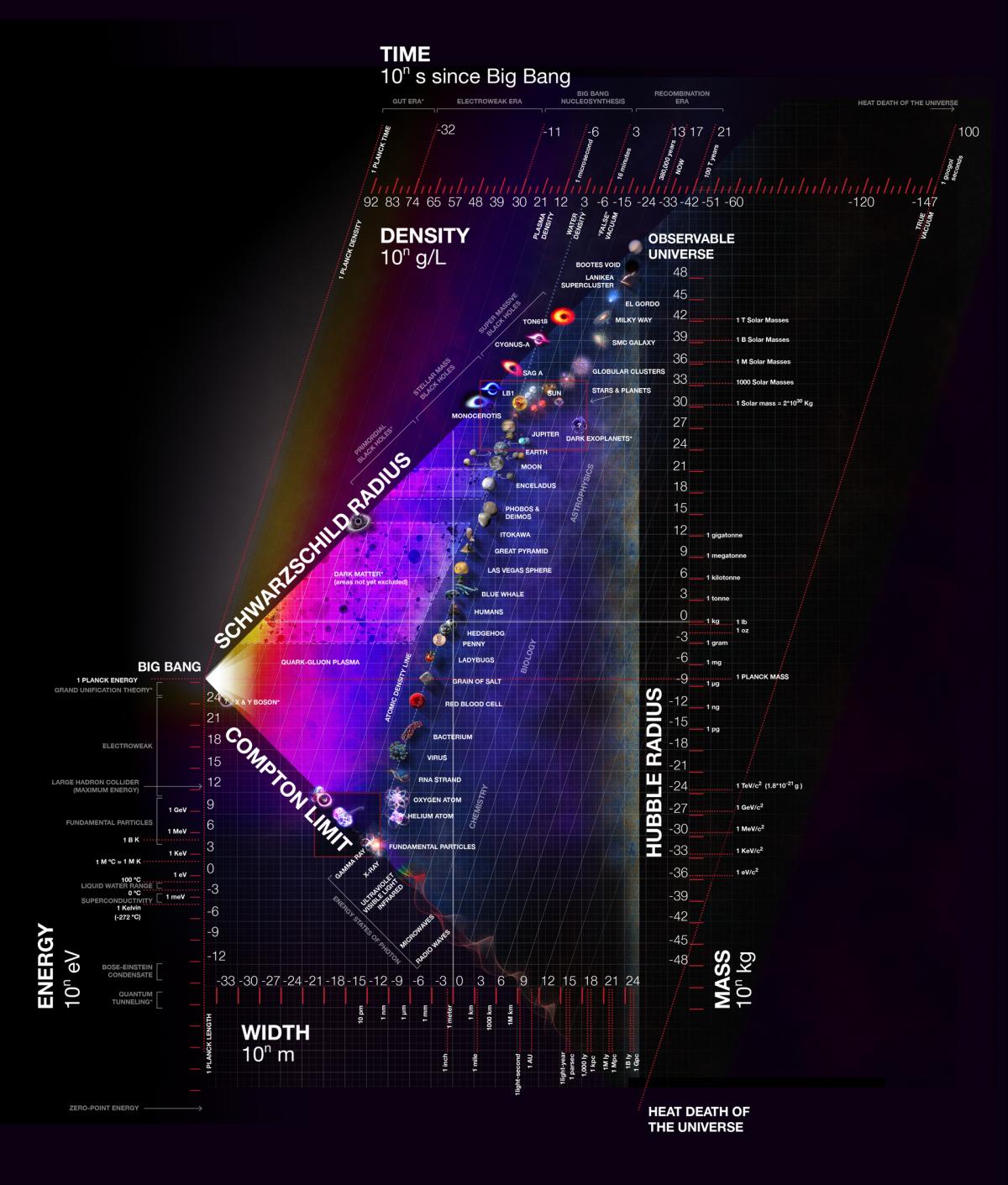
Dr. Geraint Lewis and Dr. Luke Barnes do a great job of explaining this in A Fortunate Universe: the laws of nature aren’t really the problem, it’s the initial conditions and/or ‘constants’ (the “magic numbers”) that you plug into the equations. We can’t predict these values; we can only measure them. Their extremely precise and carefully-balanced values (to quote atheist Fred Hoyle) look like a “superintellect has monkeyed with physics.”
In an interview on the BBC some years ago, Dr. Paul Davies put it this way: “The really amazing thing is not that life on Earth is balanced on a knife-edge, but that the entire Universe is balanced on a knife-edge, and would be total chaos if any of the natural ‘constants’ were off even slightly.”

Here are some examples from Fortunate Universe and Creator and the Cosmos:
- The gravitational constant (i.e., the “strength” of gravity) cannot differ from what has been measured by more than 1 in 10^35 (that’s a 1 followed by 35 zeros).
- The density of the cosmos at 1 billionth of a second after the Big Bang was about 10^24 kilograms per cubic meter. If it had been just one kilogram per cubic meter more the universe would have collapsed; if it was less by the same tiny amount, it would have expanded uselessly.
- The masses of the Up and Down quark (and their ratio) cannot vary from what we measure by more than a fraction of a percent. You’d either get a neutron-only or proton-only universe.
Those intrepid skeptics who read books like Fortunate Universe might think, “so if I double the mass of a certain quark, everything falls apart? That’s a HUGE change!” Not when compared to the range of possible values. Barnes compares it to throwing a dart and hitting the bullseye. It’s a good toss because you’re comparing against the entire width of the dart board, not just to the small bullseye in the center.
(Well … in my case, you’d include the wall, the ceiling and if a window is open, the great outdoors! But let’s press on …)
But Change, It Is A-Comin’
Whilst the Glitterati and Digerati insist that religious beliefs are, at best, a quaint superstition from man’s prehistory, there’s a growing consensus, especially in Cosmology, that it’s wrong to assign an a priori label of “irrational” to anyone who believes in God.
In 1992, Science historian Fred Burnham noted in the May 2, 1992 issue of the Los Angeles Times that “the scientific community is prepared to consider the idea that God created the universe a more respectable hypothesis today than at any time in the last 100 years.”
How can this be? Let’s look at what science has really learned in the past few decades.
If I may borrow Sam Clemens’ famous remark, I think you’ll find that the rumors of God’s death have been greatly exaggerated…
Click Click here to proceed with a look at the Big Bang, or use the menu.
* The United States Congress is the only known organism with 535 bellies, over 1,000 legs, and no brain.