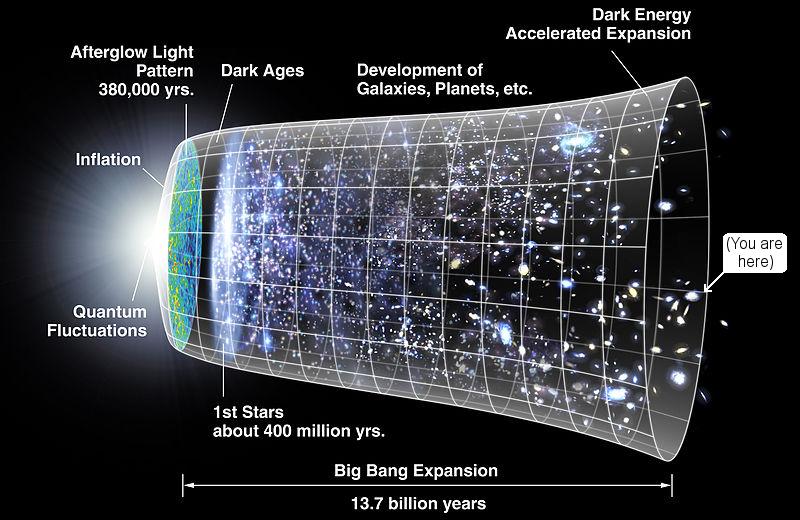

The biggest problem with the Big Bang theory of the origin of the universe is philosophical — perhaps even theological — what was there before the Bang? — Dr. John Gribbin, speaking in Nature magazine
From Steady State To Big Bang
In the online Origins discussion groups back in the 90’s, it was All Evolution, All The Time [insert jangly radio jingle here]. The same arguments would be repeated, round and round and over and over — kind of like a well-orchestrated dance, but with boxing gloves.
“Radioactive dating is inaccurate.”
“It’s radiometric dating and no, it’s not.”
“Whatever. Is too!”
“Is not!”
Then a Creationist would ask where life came from in the first place. He would be solemnly reminded that Abiogenesis (“life from non life”) wasn’t part of the Theory of Evolution.
“Whatever. Where did life come from in the first place so that evolution could do the rest?”

Plenty Of Time == No Problem
At the time, the Steady State Theory (mentioned earlier) was often cited. The universe was believed to be unfathomably ancient and huge. “Plenty of time,” would come the inevitable response. An Appeal To Many Chances, free of charge. They’d return to arguing about radiometric dating and whether the fossil record was bogus.
Science fiction writers seemed to prefer the Oscillating Universe (sometimes called the “Bouncing” or “Cyclic Universe”) — the idea that the Cosmos would expand, then contract and expand again, over and over — probably because it made for a better plot (see Fred Pohl’s Heechee series for a classic example). Another Appeal To Many Chances: who was to say that our current universe wasn’t just a “lucky bounce” that was specially suited to life?
Both theories have now fallen out of favor.
The Steady State was abandoned because the “state” of the cosmos isn’t “steady.” Better telescopes allow astronomers to look back in time; they can see that things were quite different back then. The Oscillating Universe had some technical problems (a big one is that each successive “bounce” would have higher entropy), but that’s a moot point now. The expansion of the Cosmos is actually accelerating.
Before We Get Started
I’m not a physicist. This is a laycritter’s best attempt to explain things that, to be honest, are sometimes over my head. Particle physics and quantum mechanics can be outrageously counter-intuitive, so I have greatly over-simplified this as much as possible. (You can thank me later.)
-
- The Big Bang Theory (the science, not the sitcom) is as widely accepted in Astrophysics as the Theory of Evolution is in Biology.
-
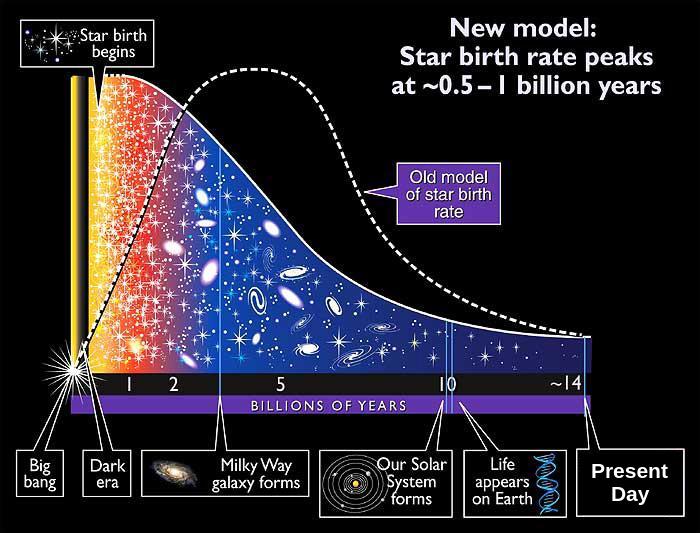
- The universe is around 13.8 billion years old. The first several billion years were spent cooling, forming stars and incrementally making the elements for planets and life chemistry. This drastically shortens the time available for intelligent life to arise.
-
- Time, as we know and measure it, does not exist outside of our Cosmos. This has critical implications for the nature of any Creator that we might propose.
-
- Similarly, our Cosmos is not a Giant Thing sitting in “space;” what we know of as spacetime is within our Cosmos (or in a sense, is our Cosmos).

Some Background
(Note: the following few sections are really geeky. If you like, you can just take my word for what follows and skip ahead to "The Cosmic Microwave Background.")
Einstein’s famous formula, E=MC², shows that energy and mass are equivalent. If you were to convert a single gram of mass (“M”) to its equivalent energy (“E”), the yield would be almost 90 trillion joules (compare this to the Little Boy atomic bomb from WWII: 63 trillion joules.)
If there’s excess energy available (as was certainly the case in the Big Bang) particles can be created spontaneously. If you change a particle to one with more mass, there must be additional energy available to meet the cost. If you’re moving to a less massive state, you’ll have excess energy/mass to dispose of.
These changes in energy level occur in discrete steps called “quanta.” Think of a cashier selecting coins to make a precise amount: in the same way, energy conservation laws require that the sums work out from end-to-end. This can include kinetic energy; a little extra push to a particle might be the “pennies” that let us make “exact change.”
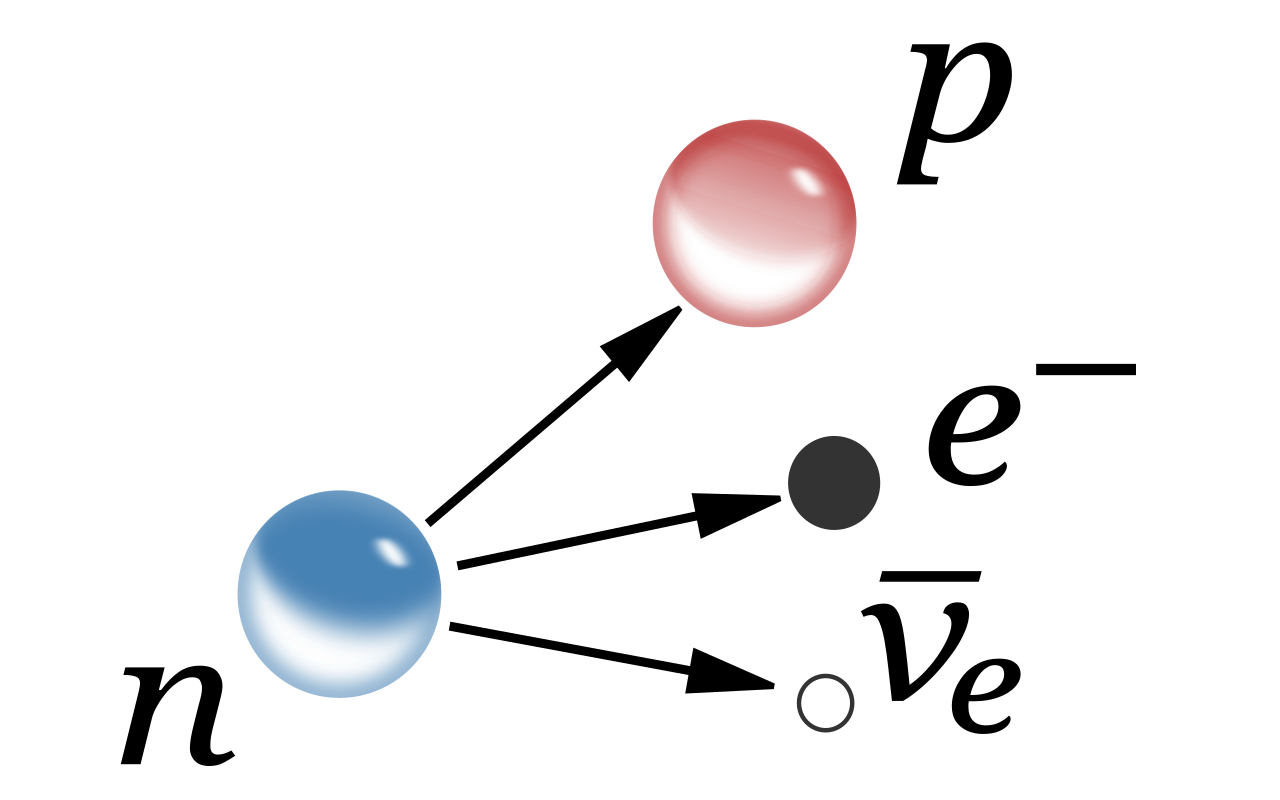
Here’s an example of a step down. The neutron is about .14% more massive than the proton. Free neutrons (i.e., those flying around loose, not part of an atom) decay with a half-life of about 15 minutes, but to make the mass-energy values work, you’ll end up with a proton (“p”), an electron (“e”) and an antineutrino (“v”, below).
Particles … It’s All PARTICLES!
Except for when it isn’t. (I told you this stuff is non-intuitive.) But this is how physicists work with sub-atomic stuff. When they discover a new force or interaction, they look for new particles.
What you and I think of as “light” is the same as radio waves; they’re just at different frequencies. The particles (or more accurately, “quanta”) that carry (or “mediate”) these forces are called photons.
The spooky “Weak Force” uses three different particles called “W+”, “W-” and “Z.” Among other things, the “W’s” are associated with radioactivity. They can change the quarks inside protons and neutrons, flipping them from one type to the other (the electron and antineutrino in the image above came from a decaying W- boson).
The “Z” boson is even spookier; among other things, it’s believed to play a part in scattering newly-created elements from supernova explosions.
I call them “particles,” but they’re both waves and particles. This is called the Wave-Particle Duality (also non-intuitive). Just think of them as little smushies of energy that are deeply weird.
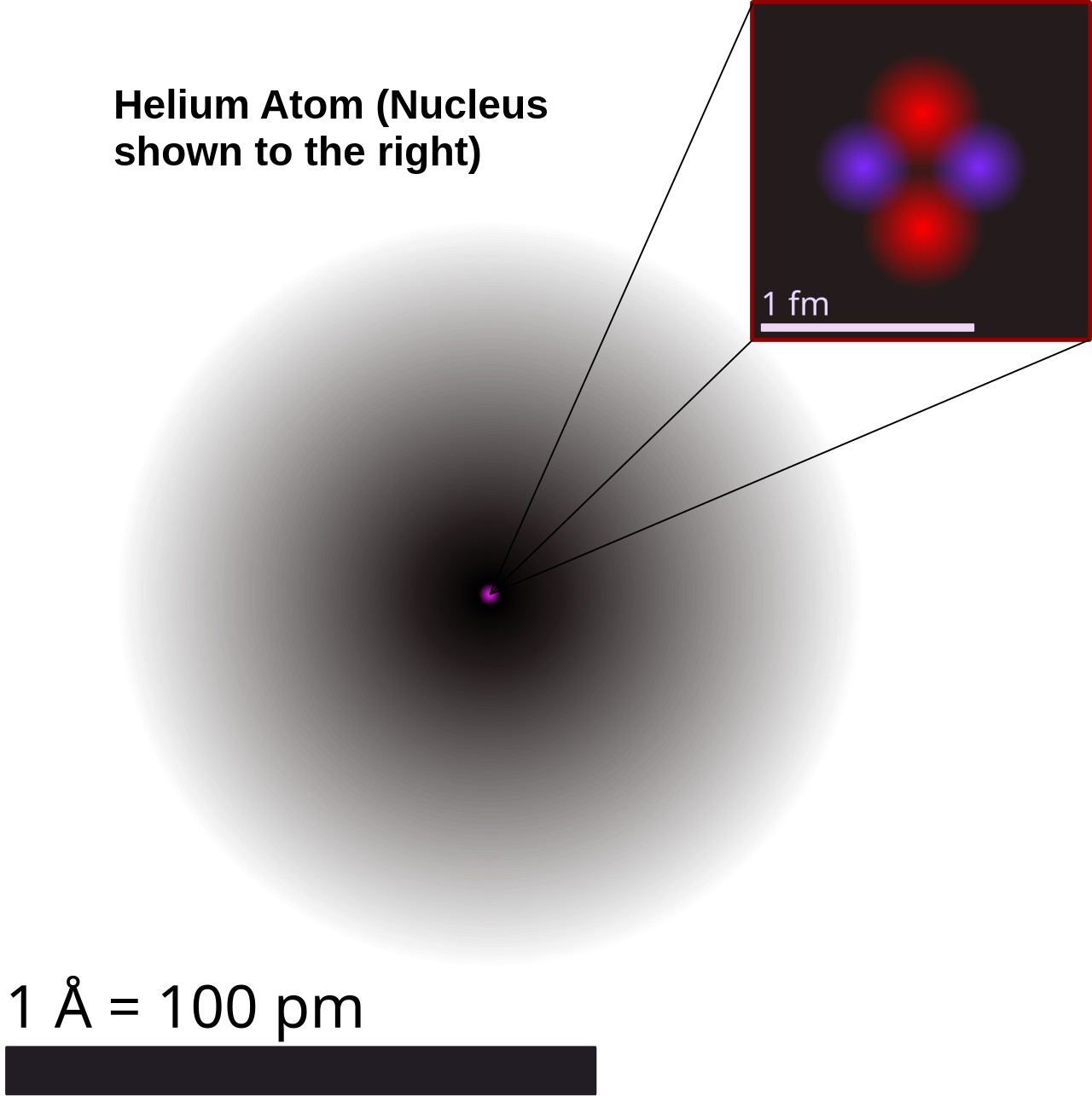
How weird? If you’re as old as I am, your science classes probably showed the electrons as little balls circling the nucleus of an atom like tiny planets. Here’s the reality (a helium atom; two protons, two neutrons, with two electrons in a cloud surrounding the nucleus):
The Particle “Zoo”
There are a bunch of different particles with rest masses ranging from zero for the photon to the big ol’ top quark, comparable to the mass of a single gold atom(!). Each has special characteristics: some have an electrical charge, some “mediate” a specific force.
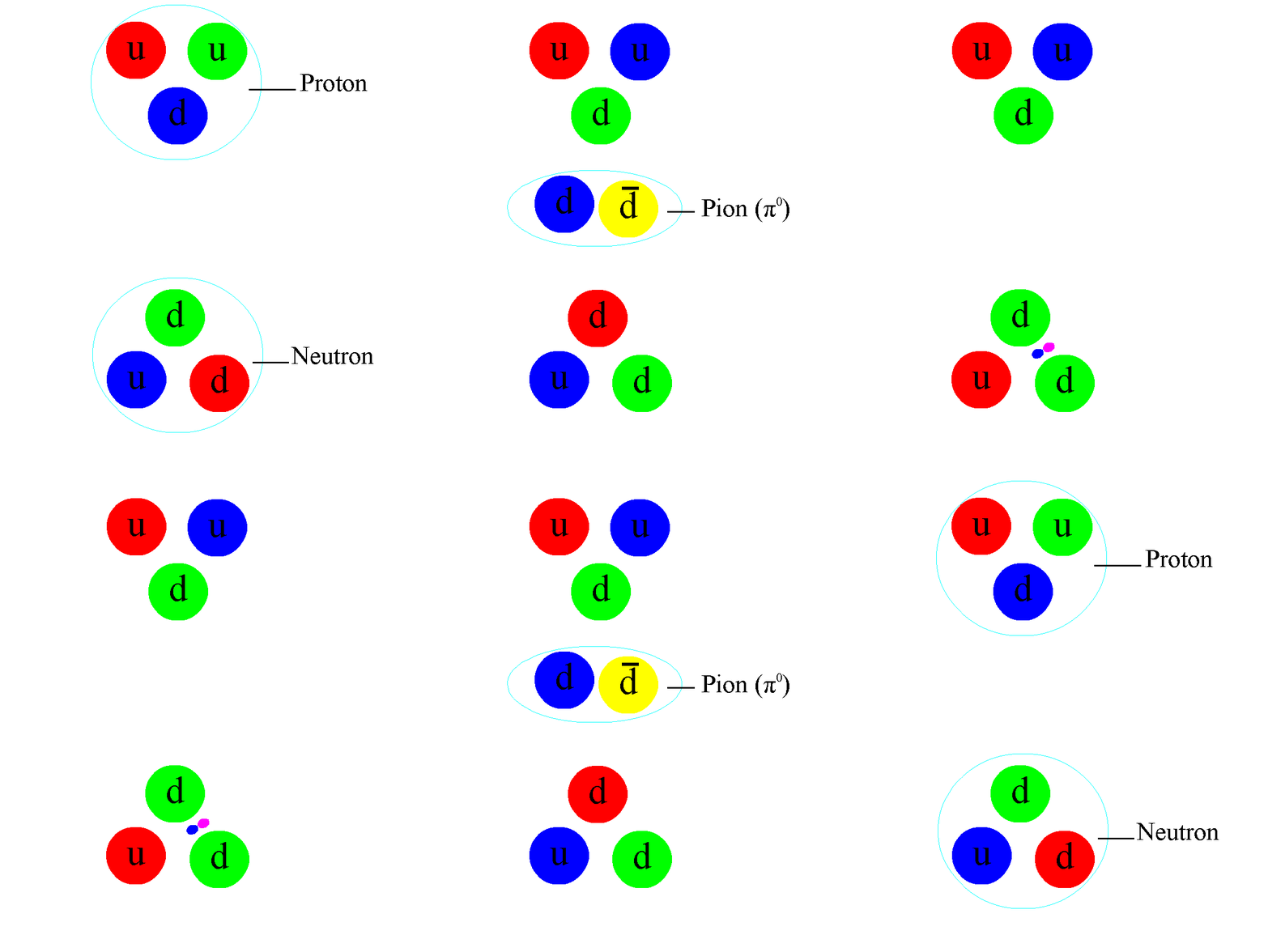
Inside of a proton or neutron, three quarks are held together by little fellows called gluons, which mediate the strong nuclear force; the study of this is called Quantum Chromodynamics.
In a neutral atom, the positively-charged protons are canceled out by an equal number of negative electrons. But in any atom with more than one proton, they’re smashed together in the nucleus. Like charges repel, so why don’t they blast themselves apart?
The mesmerizing image below explains why; in real life, this occurs many times per second. The exchange of gluons (the tiny dots) keep the quarks together. Between the separate protons and neutrons, an exchange of pions provides the strong residual force to glue the protons and neutrons together.
This also helps explain why neutrons exist in the first place, even though it takes additional work and energy to create them. In spite of the strong force, two or more protons would fly apart. The neutrons lend residual strong force to the nucleus to keep things together.
Let’s Hum A (Fine) Tune!
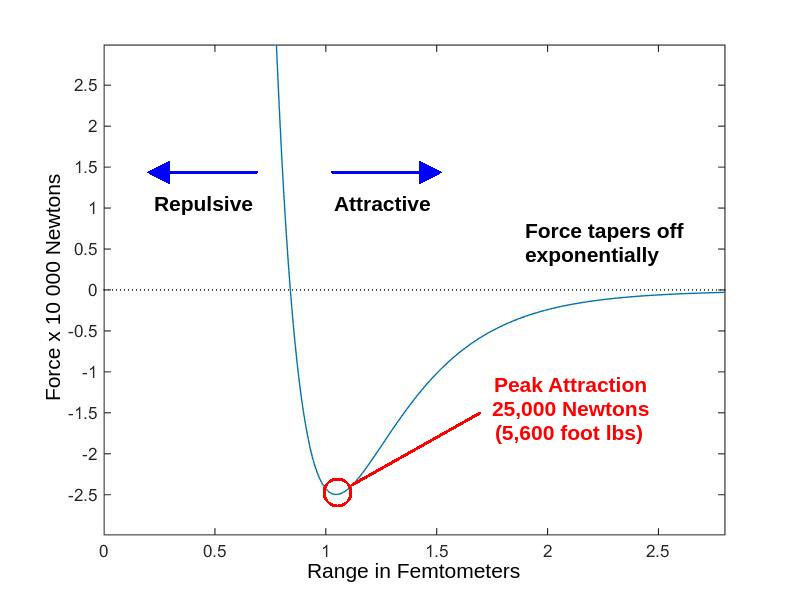
The behavior of the strong nuclear force, balanced against the Pauli Exclusion Principle (which I won’t get into), is absolutely critical. The strong interaction lives up to its name, with up to 5,600 foot lbs of force at about 1 femtometer (“fm,” a quadrillionth of a meter).
Here’s the fine tuning: the strong force attraction reaches out to 2.5 fm (see below). If it was stronger and/or worked over a larger distance, we would only have heavy elements. No hydrogen. If it was any weaker, stars would be unable to fuse lighter elements. We would only have hydrogen.
But this changes inside a proton or neutron, if the quarks try to get too close (less than .6-.7 fm), the force becomes repulsive. Otherwise, the protons and neutrons would merge and become a useless Clump Of Quarks. This attraction at just the right distance, with repulsion as a governor, is fine tuned to a fraction of 1%.
But now for some more fun!
The Cosmic Microwave Background
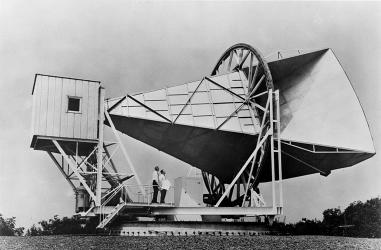
In 1992, the first Cosmic Background Explorer (COBE) satellite confirmed one of the key predictions of the Big Bang theory: “echoes” would appear throughout the Cosmos as microwaves. Penzias and Wilson had caught evidence of this back in the 1960’s with a big ol’ horn antenna, but many Cosmologists still weren’t satisfied. (Bunch of curmudgeons.)
COBE, on the other hand, convinced most of the holdouts. I watched ABC’s Nightline the very evening that the results were announced. Koppel’s famous hairdo (The Do) was flawlessly helmet-like; he had obviously spent extra time in Makeup for the occasion. The program began with a quote from the Biblical book of Genesis!
The skeptics with whom I first discussed this online were so focused on the Theory of Evolution (and debating Young Earth Creationists) that they were unaware of the then-new “Big Bang cosmology.” Even as late as 1999, I often had to explain it.
Now, of course, if you do a Web search, you’ll get as many hits from skeptic Websites as from creationist. They apparently see Big Bang cosmology and the implication of a Creator as a threat that must be addressed. But that certainly wasn’t the case for many years.
We Start With STUFF
In the 1920’s, the astronomer Edwin Hubble and some friends determined that the universe was expanding. In 1931, Georges Lemaître, a Belgian astrophysicist and Jesuit priest, used Einstein’s field equations to show that the Cosmos had expanded from a small point. In the 1940’s, George Gamow, an expatriate Russian physicist, then worked out that the universe would have been extremely small and extremely hot in the beginning.
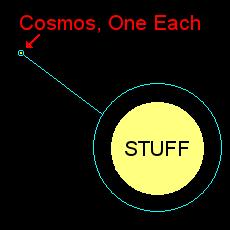
How hot? The temperature was so high, laycritters like us can imagine that everything is “melted” together into a tiny (but massive!) soup of pure energy. Nothing but pure energy. No such thing as time, no gravity, no “two objects can’t occupy the same space.” NO RULES.
More non-intuitiveness (are you seeing a pattern here?)! What today are trillions of galaxies, countless stars, zillions of planets, higga-thump-tons of water, dirt, iron, gold, air, and EVERYTHING else … was squeezed together into pure energy and it was unthinkably hot.
Because we are not physicists, we shall call this super-smished, insanely hot, soupy dot of pure energy, “STUFF.” (Reverently capitalized.)
STUFF Becomes Other … Stuff
This is where most people say, “and then it exploded.” But in fact, the baby Cosmos simply began expanding exponentially, growing from a tiny point to about one yard across (there are different estimates). Space expanded trillions of times faster than the speed of light in a trillionth of a trillionth of a trillionth of a trillionth of a second.
To picture this, imagine starting with a tiny grain of sand and in an instant, it expands to the size of our solar system(!). In a bit of a dry understatement, physicists call this Inflation. STUFF yelled, “slow down, you’re gonna get us killed!” The Cosmos did so, expanding more slowly but continuing to cool.
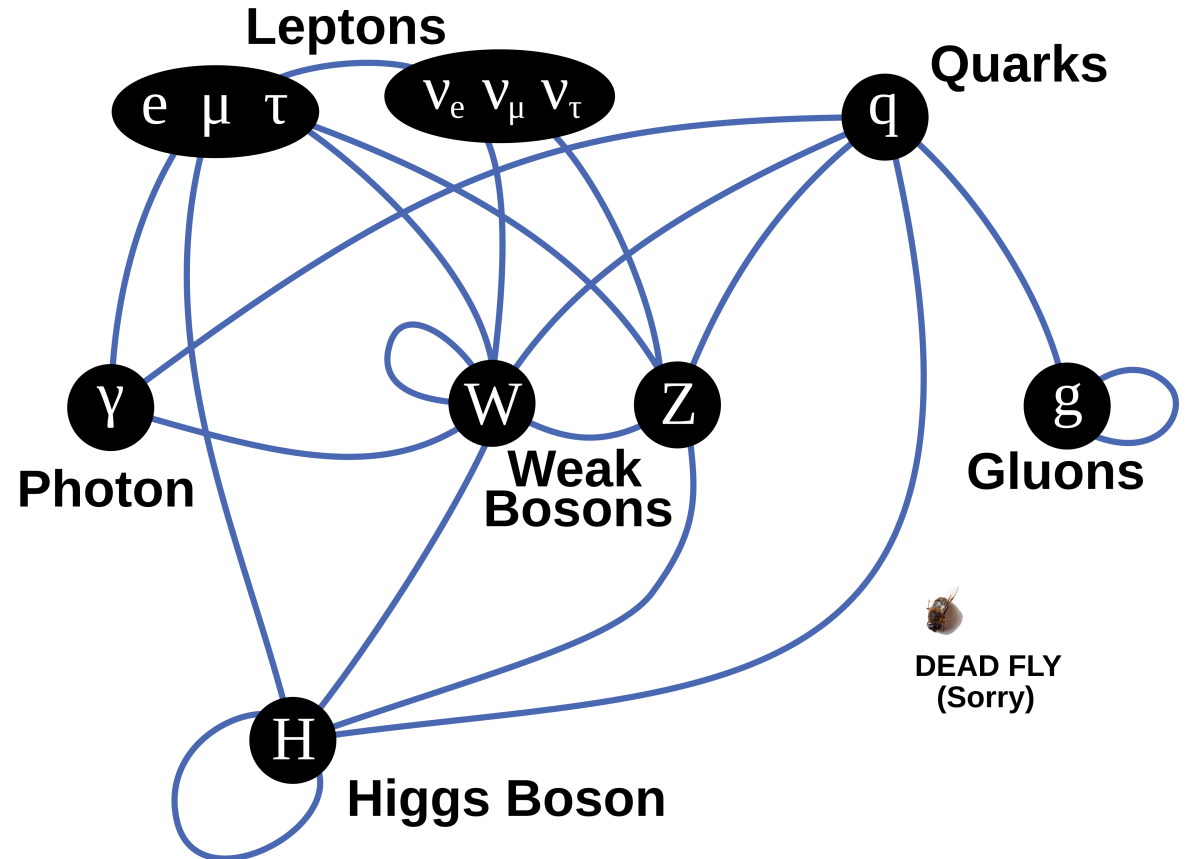
As it cooled, the elemental forces began to appear. Gravity (“gravitons”) came first. Next was the Strong Nuclear Force (the “gluons”). Then the particles that mediate the Weak Force and electromagnetism appeared. The Higgs Boson also popped up about this time and gave mass to the particles.
Print out the diagram below to impress your friends. This is the particle “zoo” with interactions (the interconnecting lines that look like they were drawn by a drunk with an old Spirograph™). Mutter sagely as you trace those lines.
The Large Hadron Collider (LHC)
How do scientists know this? They obviously can’t recreate the conditions at the very beginning.
If they tried, the authorities would probably send in a SWAT team. (Bunch of nanny-state wimps.) Even a super-sub-microscopic speck of STUFF could wipe out every galaxy in the Local Group if they lost containment. That would violate the Protected Species Act and every single member of PETA, worldwide, would git nekkid.
This is too horrible to contemplate (especially the PETA thing), so scientists have to be creative: they accelerate tiny particles to almost the speed of light, scream, “hey, ya’ll, watch this!” and smash them together. Where these particles collide, for just a brief instant, they get energies close to those of the early universe. Plenty of questions still remain, but they’ve learned a great deal, especially in the past few decades.
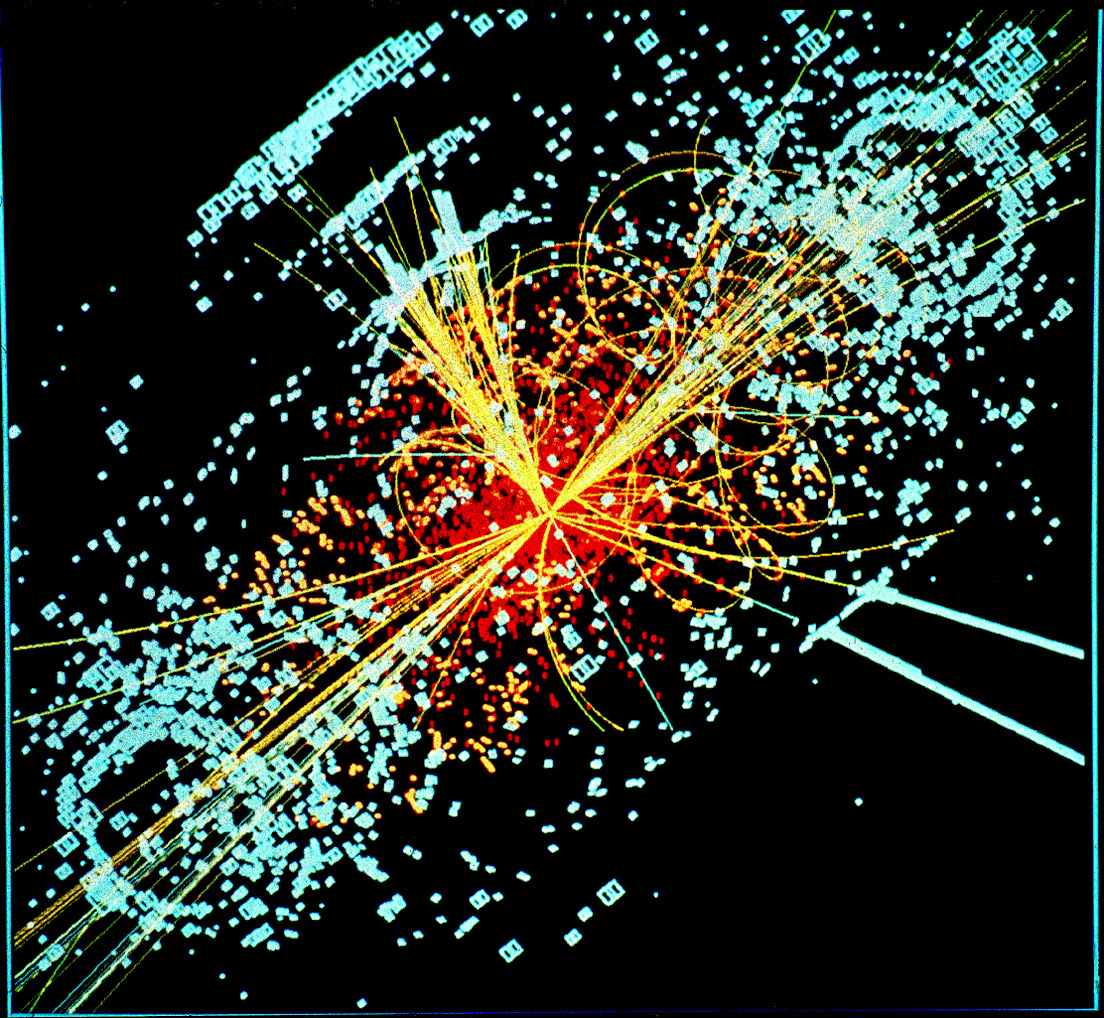
The Large Hadron Collider is the biggest accelerator ever built at this writing (but they’re planning a bigger one!) It’s a loop 27 kilometers in circumference that straddles the border between France and Switzerland. The most celebrated discovery from the LHC as of this writing is that international celebrity, the Higgs Boson. Scientists say that they can see evidence of him in the spaghetti pictured below.
Wait staff: “That’s ahhite, we won’t charge extry fer it.”
(High fives all around for the wait staff; patron eats, gains mass.)
Implications, Round One …
This one is obvious: our Cosmos had a beginning, which implies a Creator. What caused the Big Bang? How did that little dot stuffed with STUFF get there in the first place, then start expanding? What told those particles to be created with the specific identities needed for life (more on this later) as the universe cooled?
One thing that you can count on: those who try to escape the possibility of a discrete beginning to the Cosmos, and especially of a Creator, inevitably — inevitably — look for ways around it. For example, they’ll make the universe “infinite” after all (unobservable horizons), or “smear” the beginning of time to pretend that the universe didn’t actually “begin.” I mean, OK, it began, but it didn’t begin-begin.
Quantum mechanics (correctly) predicts that little virtual particles can appear, hang for a moment, then disappear. Some have suggested that perhaps the entire Cosmos popped up out of nothing. (That’s not a joke. They’re serious.)
Even if they’re right, you’re still stuck with the classic Prime Mover/First Cause problem: who or what created the conditions and/or set up the rules for a mechanism that could spit out an entire Cosmos? How did pure energy “know” to create the needed particles?
Either Way: Awesome.
Some of the String/M-Theory folks believe that a great, transcendent principle or physical law will be discovered that explains all of this. The part of me that enjoys and loves science actually hopes they do figure this out someday.
But when they do, it won’t change what I believe. In fact, I will shout like a Pentecostal on Homecoming Sunday. (They have been warned.) See, either way, they’re simply proving that God is awesome. Either He guided this Cosmos to its current arrangement, or He set up everything in advance so that it would work out perfectly on its own. Either way: awesome.
So … think about it.
Popper said that the simplest explanation that fits the facts should apply. This isn’t “scientific,” but it’s gut-check time. Apply some common sense. Isn’t the simplest explanation that our universe had a beginning … and that something (or Someone) must have caused it? And while we’re at it, wouldn’t it be obvious that God is outside of our universe?
You decide.
What (Or Who) Caused It?
The Bible clearly states that God created the universe from nothing. For example, Isaiah 42:5 says that God created the heavens and “stretched them out” (which is also rather suggestive of an expanding cosmos, is it not?).
Bible makes it clear that God exists outside of time and space. He is transcendent. If you have Dr. Ross’s Creator and the Cosmos he provides many scriptures that state this plainly (added in the third edition; see Chapter 3).
The Hebrew word for “created” in Isaiah 42.5 is bara, which means “bringing into existence something new that never existed before.” That same word appears many times in the Old Testament, including the very first sentence in the English Bible: “In the beginning, God created (bara) the heavens and the Earth.”
Hebrews 11:3 says, “By faith we understand that the universe was formed at God’s command, so that what is seen was not made out of what was visible. (NIV)” John 1:3 says of Jesus: “All things came into being through Him, and apart from Him not even one thing came into being that has come into being. (NASB)“
 God Existed Before Time Began
To quote Gribbin again: “what was there before the Bang?” The answer is, “God.” He was “causing and effecting” before this Cosmos existed (however you wish to define “before” in this case).
If you object, “how could God engage in cause and effect where there is no time?” I’ll reply, “demonstrate that cause and effect from within our Cosmos is the same as cause and effect from outside of our Cosmos.” (Another thing that many otherwise-bright people miss. In plain English: who says the Rules “out there” are the same as the Rules “in here?”)
Here are a few quotes from the New International Version (emphasis mine in italics) …
- 1 Corinthians 2:7 – …we declare God’s wisdom, a mystery that has been hidden and that God destined for our glory before time began.
- 2 Timothy 1:9 – This grace was given us in Christ Jesus before the beginning of time
- Titus 1:2 – in the hope of eternal life, which God, who does not lie, promised before the beginning of time.
God is ageless and eternal … but this Universe is not. It had a discrete beginning.
So Who Created God?
No one. Our concept of Time doesn’t apply to Him in any way, shape or form.
If God created our universe, then He obviously existed outside of time, because time, as we know it, is a property of this universe.
Anything that is timeless has no beginning. Anything that has no beginning, by definition, couldn’t have been created.
Q.E.D. You can thank me later.
(Actually, you can thank St. Augustine. That’s a very old answer.)

Click here to proceed to a discussion of how our universe was fine-tuned for life, or use the menu.