 Theoretically Speaking …
Ah, the weekend. You’re unwinding, watching a great classic movie like Bubba Ho-Tep.
But there’s something missing. You need a cat in your lap! You call his name, look around and mutter, “where did he get to …?”
… and a mouse toy comes rolling out from under the sofa. You grin. “Ah, hah!”
Now: at that moment, do you know for a fact that your cat is under there? No. But based on previous observations of how the cat behaves, you’re pretty confident that he is.
Congratulations! You’ve just gotten a tiny taste of How Science Works. Read on.

Disclaimer and Intro And Stuff
Wikipedia has a ton of stuff on the scientific method and scientific theories; click the links or do a Web search for enough detail to blow up your brain. This isn’t as cut and dried as I’m making it sound here. But the following will serve as a broad, general laycreature-level explanation of Science and How It Works.
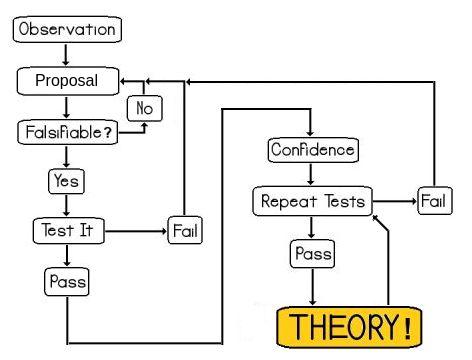
The word “theory” can have many meanings, even in science: for the record, I’m focusing on what I call tested, working theories here. Whether your favorite branch of science follows that precise methodology, the key is the little “fail” boxes in the image above. A tested, working scientific theory cannot be proven; it can only be disproven.
We can and do have great confidence in theories that pass test after test, but as Stephen Hawking says in Brief History Of Time, there’s always a chance, however remote, that they’ll one day run up against a case that doesn’t match the predictions.
For my friends in mathematics: don’t confuse this with your “mathematical theorems” and their “proofs.” Working, tested scientific theories are completely different. They’re predictive models.
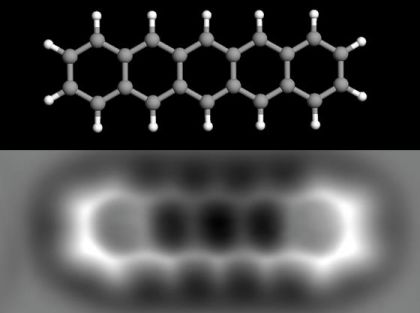
Below is an example, courtesy of IBM. The top image is a pentacene molecule as predicted by theory. The bottom is the reality as imaged by Atomic Force Microscopy.
Popper’s Rules (Nothing To Do With Puffed Corn)
The bottom line for us laycritters is that a working scientific theory is simply a model that describes or explains something. It makes predictions that can be tested (i.e., that are “falsifiable”).
Rules must be made by PhDs or politicians; in this case, a fellow named Karl Popper (a PhD, and not a politician) helped establish the rules for scientific theories. The essence is as follows:
-
- The thing being modeled must be observable.
- A scientific theory must provide a way in which it could be tested and falsified.
- A scientific theory must adequately and correctly model that which is already known.
- The simplest theory which fits the facts is preferred (this is called “The Principle Of Economy”) and anything which is not absolutely required for that model to work should be discarded.
In spite of what some skeptics seem to believe, this works just as much for the Believer as against. It’s neither pro- nor anti-religion. It’s simply a strict methodology that helps explain things … with proven results.

The Peer Review Process
You’ve no doubt seen this term in any debate about origins; what is it?
New science — from formal proposals to new research — is published in uber-geeky things with names like Journal Of The Astro-Widget Society. (I made that up. Don’t Google it.)
Getting an article (or a “paper,” if you’re a geek) published is an accomplishment. Why? Because that paper will first have to be reviewed by your fellow scientists. If it doesn’t pass peer review, it gets tossed in File #13.
(And if you’re invited to present your paper to a conference of your fellows, well, that’s whipped cream with your strawberries. Can’t tell you NUTHIN’.)
There’s a reason why scientists write popular books, or do interviews with magazines, or go on a podcast, to discuss their beliefs about God, life, religion, morality and the proper thickness of pizza crust. These things don’t belong in peer-reviewed literature.
Crafting A Scientific Theory
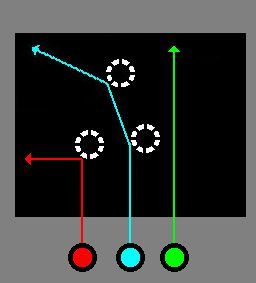
If you visited my old site, I had a silly example here about an insane pool table that had a cover over the play area (the black square in the image below). Balls of different colors struck hidden posts and rolled off in unexpected directions.
It did illustrate something important: a scientific theory can only model things that are observable, but that includes observable effects. When you saw that mouse toy roll out from under the sofa, you were observing an effect. You didn’t actually see your cat.
With this pool table, even though you can’t see the obstructions, careful experiments and firing a bunch of balls can tell us (1) how many posts there are and (2) where they are and even (3) what shape(s) they have.
(You might now ask: how has the Big Bang been confirmed? The biggest success is the Microwave Background Radiation; more on this later.)
Now for some more fun!
Building Confidence
Each time a theory passes a test, confidence in that model increases. We call Albert Einstein a certified genius nowadays, but when he first started publishing, quite a few people were skeptical. He passed peer-review because he had his math in order, but that didn’t mean he was correct.
We can translate one of his predictions into Laycreature-Speak: “if gravity is due to the curvature of space near a massive object, then a beam of light will follow the curve (i.e., can be ‘bent’ by gravity).” That’s clear, concise and objectively testable. This and other predictions were eventually confirmed by many experiments. Scientists then had confidence in Einstein’s work.
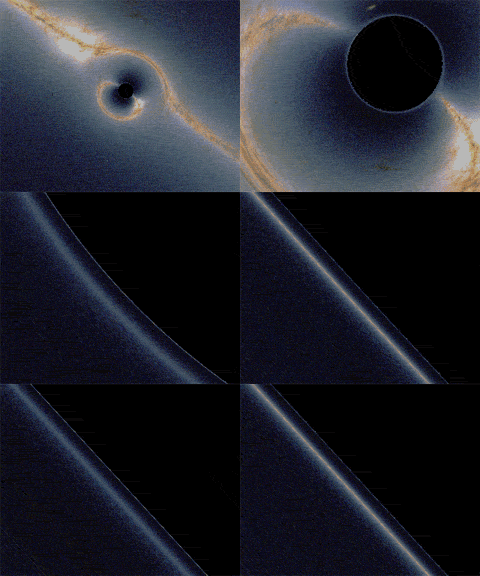
The animated GIF below is a simulation of what it might look like to head toward a massive black hole. The light behind the hole bends into what are called “Einstein Rings” due to the intense gravitational field. It’d be absolutely spectacular … but there would be a small downside.
See, you’d be on a starship filled with (briefly) screaming people; the tidal forces would stretch everyone like naughty peasants in a medieval torture rack. Everything would soon be ripped into a fine mist. The thin, flat cloud of particles that used to be you (and the ship) (and your fellow passengers) would emit some gamma rays and stream into the hole, lost behind the Swarzchild radius.
Models And Sub-Models
“Evolution keeps changing … which theory is right? Punctured Lubrication or Class-sized Graduations?”
No. Just … NO.
A tested, working theory is just a model. There may be more than one model to help describe something, or (more commonly) you may have One Big Overall Model that consists of, or contains, a bunch of smaller models.
For example, the basic, bottom line Big Bang Theory just says that the universe started small and expanded to its present size. The most-accepted variant right now is the Inflationary Big Bang.
As proof that the popular media don’t get this, you’ll see headlines that blare, “Big Bang Replaced By New Theory!” As you read the article, though, you’ll see that physicists have simply tweaked the theory and have improved some things. This happens all the time in science.

The Models Change And Improve
Newton’s math for gravity and motion isn’t perfect, but it’s close enough for most work. Astrophysicists prefer Einstein and his successors because the newer theories are more accurate. They cover some cases that Newton missed (a famous example involves the orbit of Mercury).
Some theories seem to work for a while, but eventually run into something that they can’t explain. When that happens, scientists will warn that the theory has problems in these certain cases. They’ll then modify that theory, or come up with a new theory, to better model things.
This doesn’t mean they were “wrong” (any more than Newton was “wrong”); it just means they know more and have improved the model(s) to fit. This is a perfectly normal function of science and it occurs all the time.
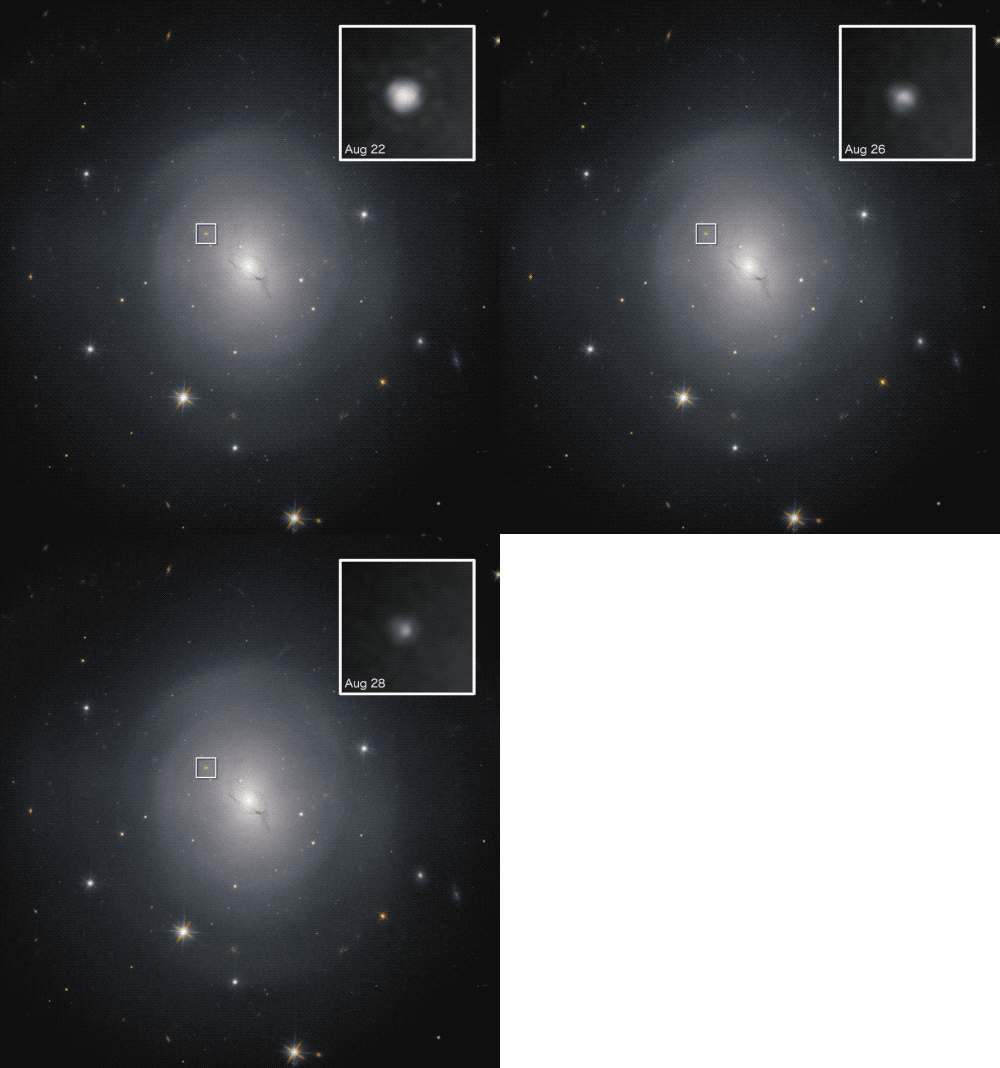
Those of you who visited my original site may recall how much fun I had with gravity “hugging and squeezing George” when I described Betelgeuse exploding as a supernova. I had to reword it. Many heavier elements are now believed to come from neutron star mergers (which also result in powerful gamma ray bursts and a kilonova).
For My Fellow Believers
This is why miracles have no place in science. You may think that scientists are opposed to the miraculous by nature. Sure, they’re human; some of them are. But there are plenty of Believers in science (much to the annoyance of hardcore atheists who are convinced that only people who flatly reject the existence of God can truly be “objective”).
Look at the flowchart at the top of this page one more time. Now, tell me how you’re going to formally test the idea that, “I prayed for God to heal my cold and He did, hallelujah!” Hey, I might believe you, but that would be something I would take on faith. I can’t disprove that God healed your cold. See how this works?
Scientists also need repeatability: if you pray for your neighbor today and he is healed, they want you to be able to pray for someone else tomorrow and have the same thing happen, on demand.
Most of us know at least one amazing story, often told by a doctor, of a patient who wasn’t expected to live, but who “mysteriously” got better. But again: how would science objectively and repeatably measure this?
Radiometric Dating And The Age Of The Earth
This is also for my fellow Believers. I gain no pleasure from this, but I’m saying it in love. Those who insist on a “young earth” — for example, the Institute For Creation Research (ICR) and Answers in Genesis (AIG) — have made all sorts of strange claims about the age of the Earth, archeology, geology, and even the Big Bang theory itself.
Don’t get me wrong; if you believe that the Earth is only 10,000 years old and that the days (Hebrew “yom”) in Genesis are literal 24-hour periods, that’s fine with me. But don’t use misleading, cherry-picked and unscientific arguments to support that.
(One other thing you may not be aware of, but I’ve seen this first hand. When a Young Earth creationist finds him or herself in front of a friendly audience — for example, a conservative church fellowship — they have a tendency to make claims that they normally wouldn’t in a debate with a well-known atheist.)
And here’s a tip. If you find yourself in an online debate with a skeptic, don’t waste your time trying to prove that the Earth is less than 50,000 years old. They’ll provide Web links that will refute every single claim. This includes virtually the entire litany. For example:
- “The Earth’s magnetic field couldn’t have lasted for 4 billion years!” Sure it could, and the paleomagnetic evidence is solid. I’ll cover this later in A Home For Life.
- “The rate of erosion means that the Earth can’t be billions of years old!” Plate tectonics and volcanic activity easily account for the existence of mountains on dry land.
- “Canyon Lake Gorge in Texas formed in a few days — this proves that the Grand Canyon didn’t need millions of years!” The Grand Canyon is primarily granite and schist, while the catastrophic flooding in Texas was through soft limestone and sediment.

For myself, I decided years ago that the “days” of Genesis were very long periods of time, especially after I accepted that it was an eyewitness account. (More on this later, too.) In their determination to “prove” that the Earth is less than 50,000 years old, Young Earth Creationists are not only engaging in bad science, they’re taking away one of the most effective witnessing tools for non-believers.
I also have to say this. What really irks non-believing scientists is the claim that they secretly “know” that “radioactive dating” is bogus, but cling to it solely because they won’t believe in God.
First, there are plenty of Believers (some quite conservative and Bible-believing ones, like yours truly) who have no problem with an “old” Earth. Are they part of the “conspiracy?” Second, what you’re really doing is, you’re accusing these scientists of intellectual dishonesty, shoddy work or worse. For some reason, that offends them. (Go figure.)
There is great confidence in these methods nowadays. They’ve been refined for many, many years, too. What most laycreatures don’t know is that, when scientists date something, they don’t just use one method nowadays, either. They’ll sanity-check themselves whenever possible by comparing the results from as many different methods as they can use.
The Key Point!
Believers have nothing to fear from science … provided it follows its own rules fairly.
I said that I would show you that either this universe is designed, or it’s just one of many. This is so important, I’m going to put it in bold text: both viewpoints (especially at present) require faith, because neither can be “proven” (either literally or in the scientific sense of “confidence” in a robust theory). You can certainly argue that your “belief” is better than mine, but at the end of the day, that’s all it is.
Many atheists will say, “religious people believe in that which can’t be seen or reliably demonstrated; rational people believe only in that which can be demonstrated.” I wish it were that clear-cut, but OK, let’s take that at face value. One day I will see that in which I believe; you believe in what you can see now. (Except for multiverses. And a few zillion other things. But hey; I said I’d take it at face value.)
That’s your choice and I’ll defend your right to it. But at the end of the day, it’s still faith.
I’m not a philosopher and frankly, I would rather watch paint dry than to start debating semantics and parsing terms. If you want to argue, I won’t be here. I’m headed toward the next page. But first …

A Final Thought About Multiverses
Paul Davies has a good discussion about what scientists believe in the Appendix to Cosmic Jackpot. There is indeed a strong consensus that this universe appears to have been designed for the emergence of carbon-based life, but there are differing opinions about what it means.
According to him, most scientists just choose not to think about it: they get on with the business of digging and observing and crunching numbers, perfectly satisfied to leave it as a mystery that doesn’t affect them (or their work) personally.
Other scientists, says Davies (especially String/M-Theorists), believe that a set of laws and principles will eventually be discovered to explain the design: a Grand Unification-ated And Splendid Theory of Everything will cover it all. But there is a growing consensus for the multiple universes (multiverse) idea: our cosmos is just one of zillions, and is one of the “lucky” ones. Somewhere out there, far beyond our ability to observe, is a vast array of realms that are either cold and dead, or unthinkably hot and dead. Of course our cosmos looks designed, but then it would, wouldn’t it?
Remember the Principle of Economy (see Popper’s Rules above). For me to accept the concept of multiple universes, scientists will have to show me that they have a thoroughly-tested, robust and falsifiable theory that absolutely requires these other realms to explain what we see in our realm. I don’t think they can do that and for the record, to date, no one has been able to.
Click here to continue with a look at Watchmakers, or use the menu to hop to wheresoever you desire.