

As we look out into the Universe and identify the many accidents of physics and
astronomy that have worked together to our benefit, it almost seems as if the
Universe must in some sense have known that we were coming. — Freeman Dyson
Stellar Fusion (For Laycreatures)
The simplest description of nuclear fusion inside of a star is that you’re smashing atoms together to make a new element. Well, actually — you’re smashing the nuclei together. It’s so hot, the electrons have been stripped off.
(Having a bunch of hot, angry electrons who’ve been kicked out of their nice shells helps explain why stars have strong magnetic fields. But let’s lay that aside.)
In an active star, the core is kind of like a mosh pit: the nuclei are dancing and bouncing around. The like charges of the protons want to keep them apart, but if two nuclei come very close together, very quickly, the Strong Nuclear Force overcomes the repulsion and the nuclei will “tunnel” together. Y’gets a new element.
Fusing hydrogen to helium releases a lot of energy. Our Sun is currently in this phase of “burning.” But as you fuse heavier and heavier atoms, you get less and less energy. When you reach iron, it takes more energy for fusion than you can get from the “burn.” The mosh pit dies quite spectacularly, as I’ll cover below.

A few more fine points: as you’ll see from the images below (in my discussion of “George”) of a star like Betelgeuse, the elements drift and sort into layers over time — heavier ones near the core, lighter ones toward the surface.
As the star ages and the core gets hotter, there can be enough heat for the fusion of lighter elements at the boundary layers. But a smaller star like our Sun isn’t going to “layer up” like this. The core won’t fuse anything beyond carbon. It might still be hot enough, but once the hydrogen fuel has been exhausted, core fusion stops. The core collapses and the outer layers fall inward, hit that white-hot core and you get a final fusion flash that pushes the outer layers away, off into space.
A larger star can “throw off a shell” or “lose a layer” multiple times. And all stars can flare or flash for a number of reasons. But that’s for another day.
Fast-Forward …
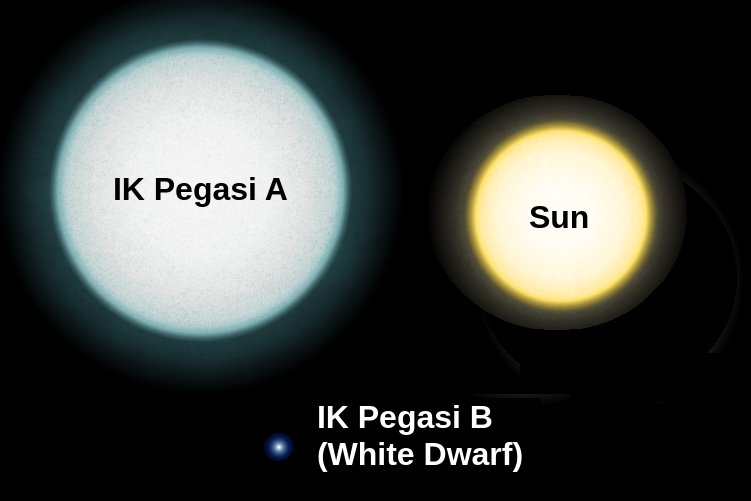
OK, let’s pick up where we left off last time. We’ll fast forward to about 380,000 years after the Big Bang. By this time, the universe has cooled enough for electrons to marry up with the nuclei created in the first minute, creating h’actual h’atoms of hydrogen (and some helium, with a smidge of lithium just to keep everyone happy).
This was the original Interstellar Medium (or “ISM,” if you’re an Astro-Person): essentially just a slowly expanding cloud of hydrogen. Over many millions of years, gravity formed clumps that drifted together, then flattened out into gigantic, slowly spinning disks called galaxies. Local concentrations of hydrogen clumped to form stars.
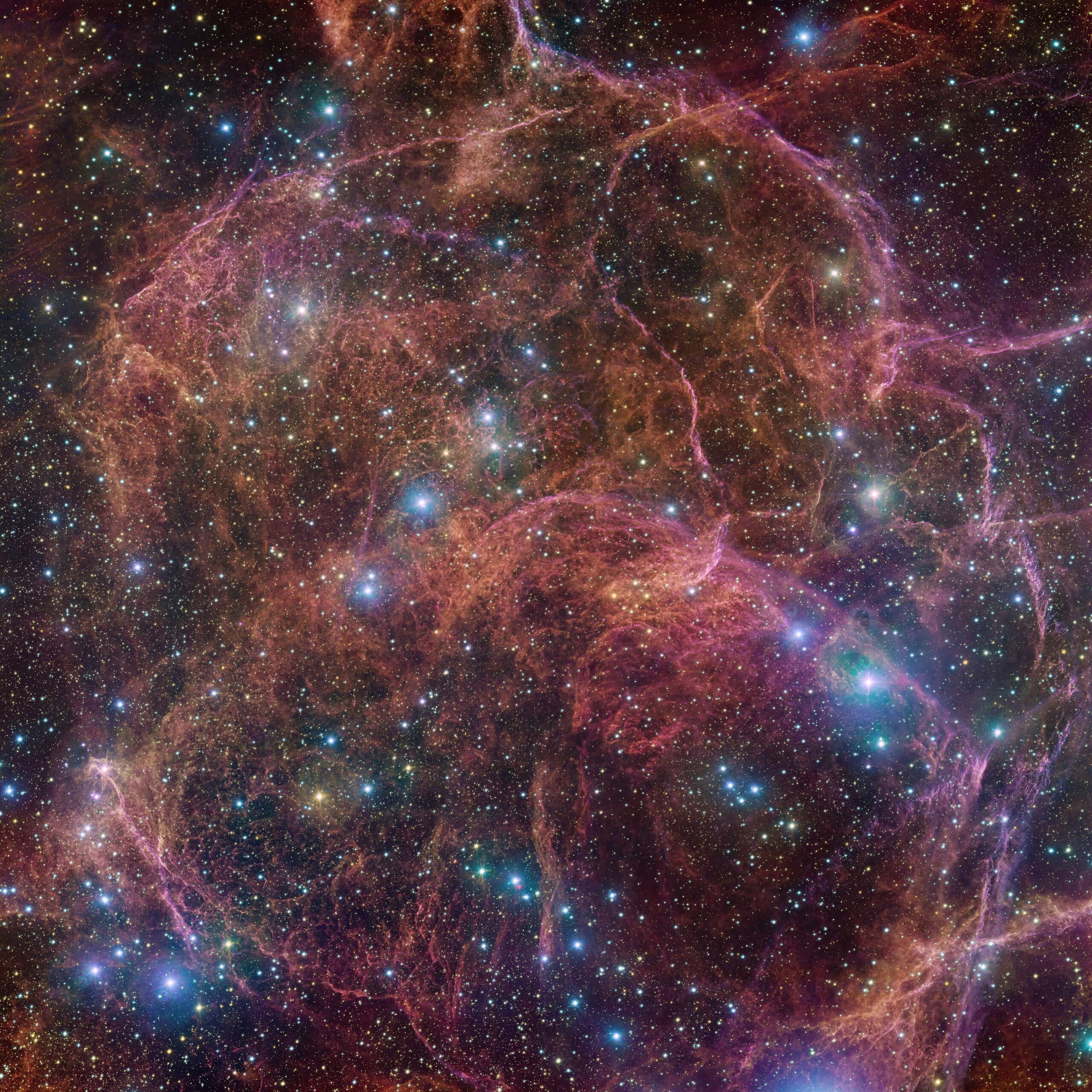
Some of these stars were massive enough to explode as supernovae, adding heavier elements to the ISM. In time, the hydrogen and helium gas was enriched with 1-3% of elements like silicon, iron, and other “metals.” (To astronomers, anything heavier than helium is a “metal.”)
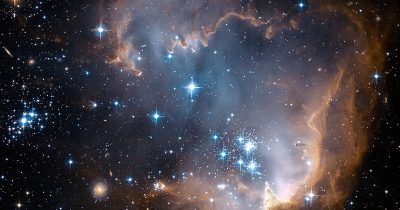
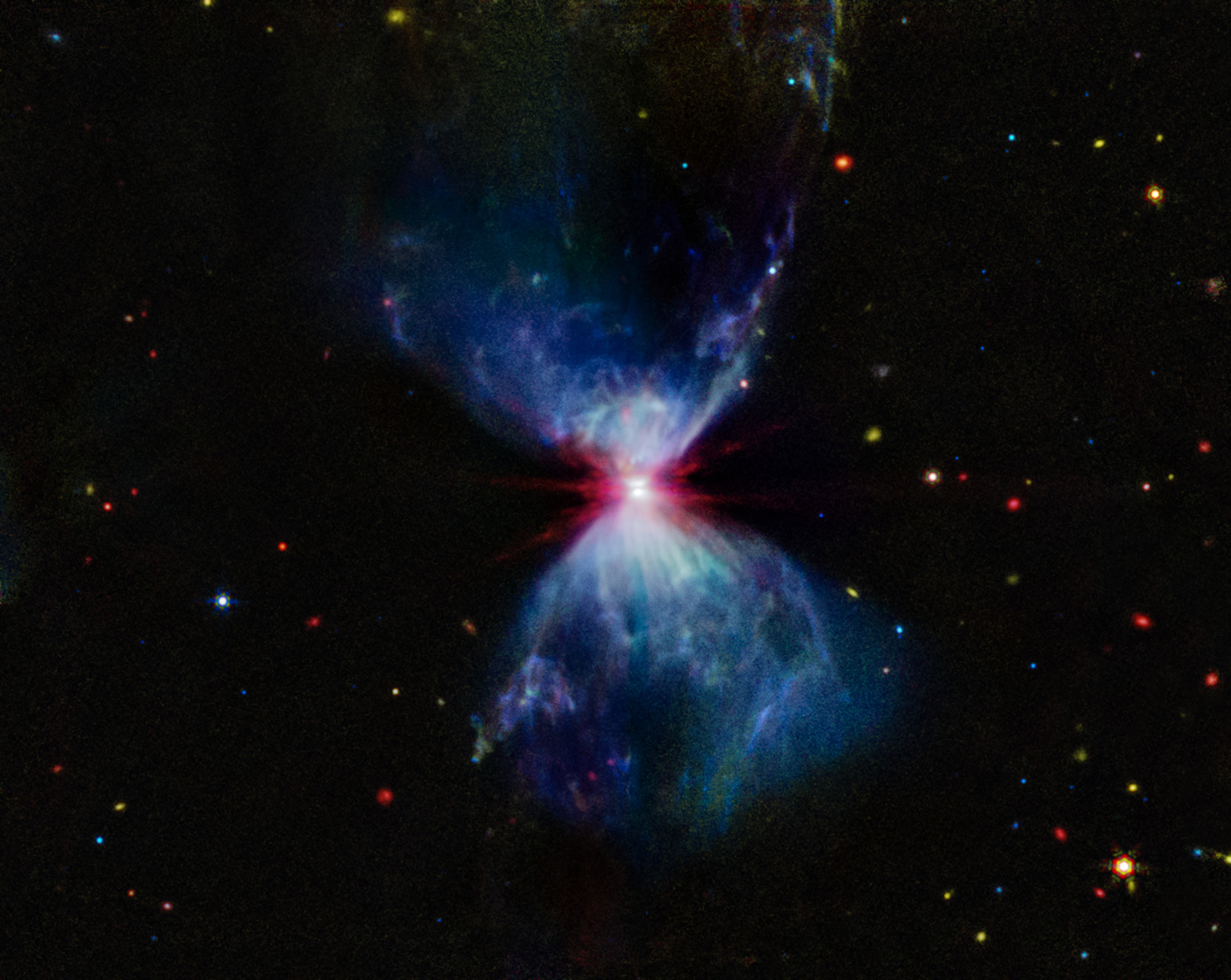
As time passed, some of this enriched ISM material, bumped into waves by everything from gravitational influences to additional supernova, formed protoplanetary disks. The gas fell into the center of the disk and formed a star.
“Elements, My Dear Watson!”
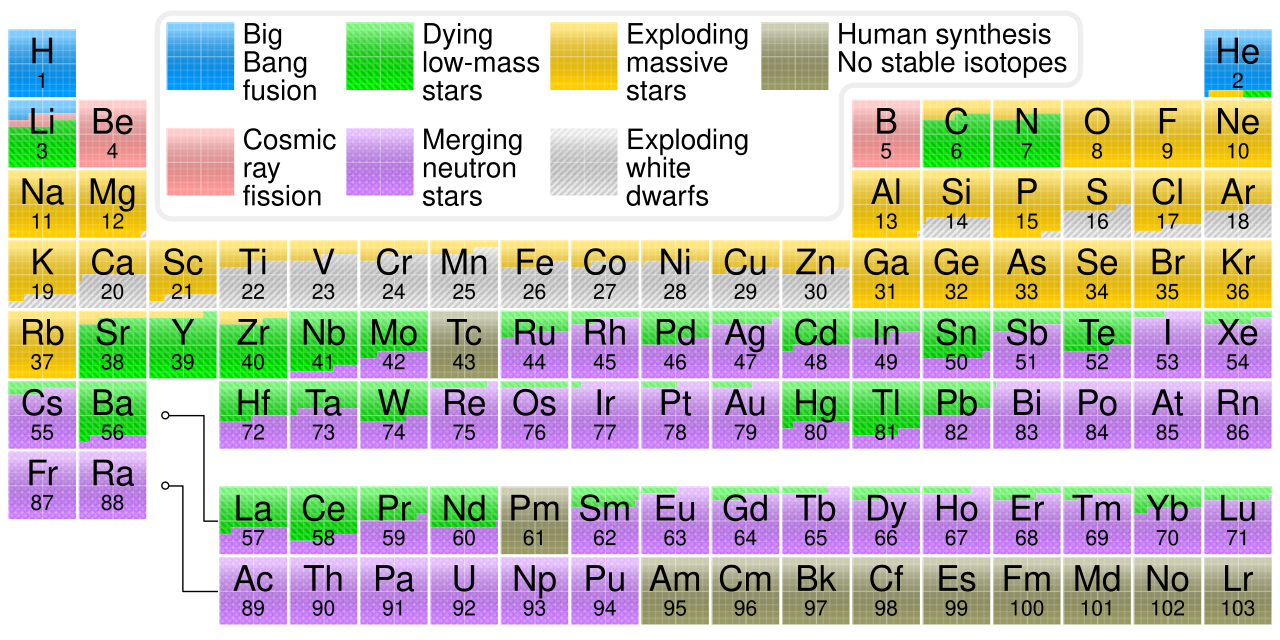
Now let’s take a look at the elements that you had to memorize when you learned the Periodic Table (I’ve also posted an image below) in science class.
The number of protons (called the “Atomic Number”) is what determines an element’s identity. At room temperature, hydrogen has a single proton; it’s a flammable gas. If you add a second proton, you get helium, which is a gas, but is not flammable. Add a third proton and you get lithium, which is a metal. And so on.
By the late 1950’s, physicists had a good idea of how these elements were created through nuclear fusion. Fred Hoyle, working with Willy Fowler and the Burbidges, Geoffrey and Margaret , developed the theory of stellar nucleosynthesis: “heavier” elements were created in stars.
But there is a huge difference in the abundances of each element. It’s not hard to guess why there’d be more iron (“Fe” in the illustration at that link) than gold (“Au”); the precious metal is a larger and “heavier” atom. But why is there so much more sulfur (“S”) than fluorine (“F”)? The stinky yellow stuff actually has a “heavier” atom than the stinky gas!
The first step in new element creation is helium (2 protons), and when you start fusing it to make heavier elements, there’s a bias toward even atomic numbers (i.e., numbers of protons). But there’s more to it. It turns out that this is written into the laws of nature — another “coincidence.”
“I Will Love Him And Hug Him And Call Him George!”
As usual, I’m providing a brief, inaccurate overview. (Besides, I’m having fun.) My examples will be limited to two stars: our Sun and a typical red supergiant. Nor am I going into all the gnarly details. If you look at that periodic table below, you’ll see that elements can be created in different ways. As usual, I’m oversimplifying. (You can thank me later.)
But I’ve already alluded to this: high pressure means a high temperature. When you see a shooting star, that meteor burns up because it compresses the atmosphere in front of it.
(You may remember that I also said that the strength of gravity cannot vary by more than a tiny amount; one reason is because the temperature inside of a star is directly related to how hard gravity can smish things together. If you change that, you might still get a star than could fuse elements, but the resonances that I’ll discuss below will be changed as well.)
(Remember: the initial conditions, constants and laws of nature are interdependent. Yes, if you change one, you’ll find that you have to change a bunch of different parameters, just to get a Cosmos that works, much less support intelligent life.)
OK: out in space, in the middle of a protoplanetary disk, gas collects and is squeezed into a ball by gravity. If the temperature goes high enough, you get fusion: hydrogen is “burned” into helium.
Gravity wants to keep hugging and squeezing and calling the core “George,” but the fusion of lighter elements releases a lot of energy. If George is squeezed too hard, more fusion occurs, which pushes back against gravity. If the fusion drops off, gravity squeezes harder, so the fusion ramps back up.
This can take a while when a star first fires up, during which you don’t want to go anywhere near it. It’s spitting junk and spewing radiation that will kill you in a minute. But eventually, a nice, self-regulating balance is reached.
(The geeks call this “hydrostatic equilibrium,” for those who like fancy terms.)
Resonances
The temperature determines which elements will be fused. Heavier elements require a hotter core, but release less energy when they fuse. I’ve already mentioned that, but it’s important.
Once a star’s core burns all of a given element, the fusion tapers off. Gravity can say, “I love you, George!” and squeeze harder, ratcheting up the temperature. The core finds a new (and denser) equilibrium, “burning” a heavier element. Additional burning of lighter elements can occur at the layer boundaries.
OK, so we start by fusing hydrogen (H, left top in the table below) into helium (He, all the way to the right). Now what? The next element is lithium (Li, to the left, second row) , but it’s rare in nature. Maybe beryllium (Be)? Boron (B)? They’re uncommon as well.
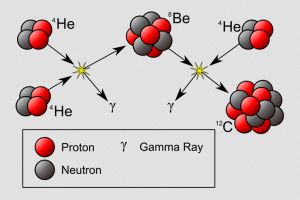
This was actually one of the first “fine tuning” things to be discovered. Fred Hoyle once did some calculations and felt that carbon should quickly break back apart into helium nuclei. BUT … if there was a “resonance” at a certain temperature, lots of carbon could be made. Scientists later found it right where Hoyle said it should be, and it’s called the “Hoyle resonance” in his honor.
We can oversimply this for laycreatures; back to the “mosh pit” at the center of that star. Just as a crowd goes wild when some Slayer or Cannibal Corpse* starts blasting, at certain temperatures, some nuclei become insanely excited. They’re far more likely to fuse (and/or stay fused) at certain specific temperatures.
By a happy “coincidence,” as stars age and the core becomes hotter, step by step, they precisely hit or miss these “resonant” temperatures as needed for life chemistry.
For example, gobs of carbon will be made because of the Hoyle resonance. But later on, the star’s temperature is just far enough off of resonance to make plenty of oxygen — without destroying all of the carbon that was created previously. The bottom line is that we end up with plenty of CHON — Carbon, Hydrogen, Oxygen and Nitrogen — the key elements for life as we know it.
Why, it’s almost as if the universe knew we were coming! (Freeman Dyson said so.)
Objections (And Answers)
We met Victor Stenger on the previous page. He argues, borrowing from Steven Weinberg, that this particular resonance isn’t that big of a deal. But remember what I said about keeping up with this stuff? You can’t just read a dismissal of one of these “fine-tuning” things and consider it settled.
I mentioned Luke Barne’s critique of the Fallacy of Fine Tuning above. It’s a PDF, but you may click that link, open the PDF, then search for “Resonance” in that paper. Basically, translating what Barnes says into laycreature-language, for life as we know it in our Cosmos and based on what we know now, this resonance must be what it is to within .4%. (That’s point 4 percent.)
Let’s revisit another objection. Some skeptics (including Stenger) complain that you can’t just “adjust one force” and then be amazed that it makes life less likely. As proof of what I said — that this not only doesn’t help them, it actually makes it worse — Barnes points out that when the fine structure constant is added to the mix, this becomes even more critical.
The fine structure constant’s value must be within .001% of what we’ve measured, or the “Hoyle resonance” wouldn’t help us at all. Stars would either make gobs of carbon or gobs of oxygen — not both. We wouldn’t be here.
Ahhhite! Let’s blow up some stars!

Small Star: Get Old, Grow Big, Then Die
All stars consume themselves as they age, fusing lighter into heavier elements. The larger the star, the more quickly it burns itself up. Our Sun is small enough that it will continue burning hydrogen to helium for billions of years.
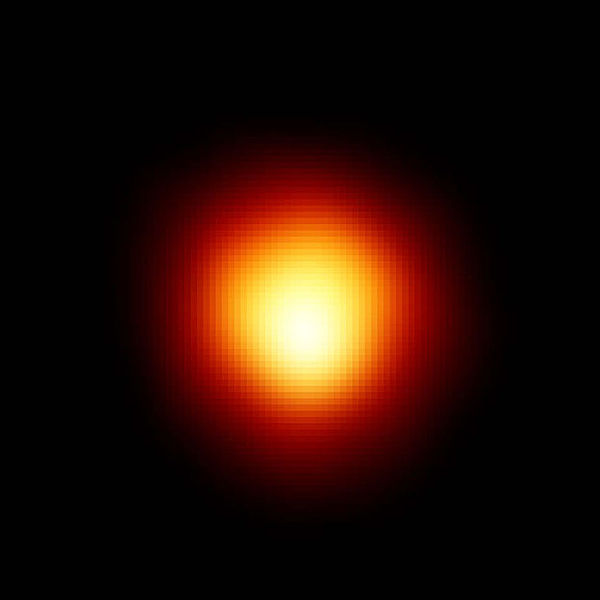
Betelgeuse in the constellation Orion, on the other hand, is a red supergiant. It has at least 16 times the mass of our own Sun and won’t live beyond 10-15 million years. In fact, ancient Chinese records said that the star was yellow and now it’s red, so it’s nearing the end of its life. Scientists estimate that it will go supernova sometime in the next 100,000 years.
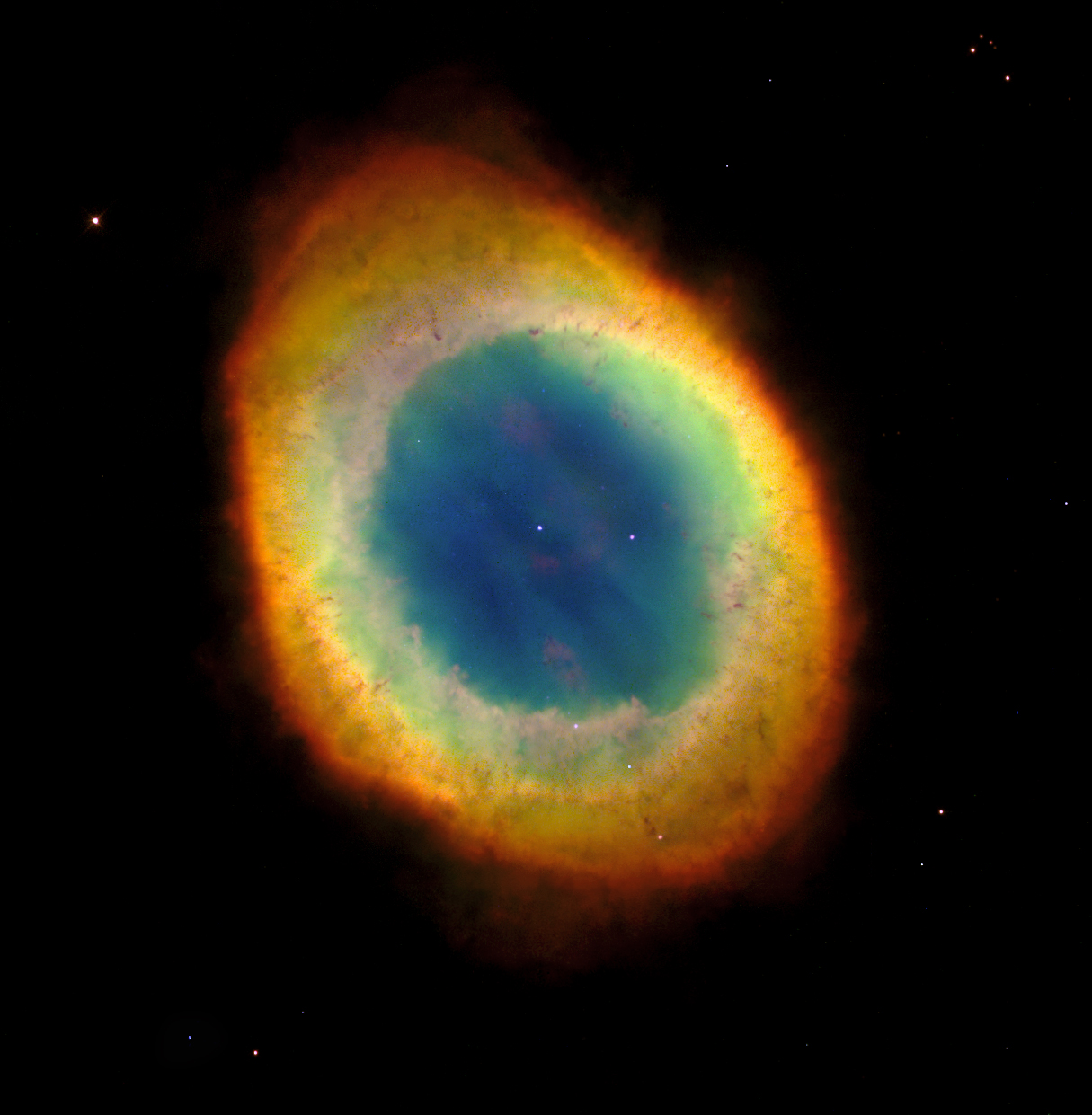
Back to our Sun. Billions of years from now, it will start making carbon and will swell into a red giant. Eventually, our star dies with a sigh: as described above, a final flash will shed the outer layers; the core will become a white dwarf star.
We get a beautiful Planetary Nebula — a misleading name that was given to them back in the late 1700’s, but we’re stuck with it now.
Big Star: Get Old, Go BOOM
To get lots of heavier elements, you need an already-exhausted dwarf star that can steal gas from a close companion or (as mentioned earlier) a neutron star merger, but I’m not going to cover those. We’ll use Betelgeuse, a red giant star in Orion, as our classic example. Der Beetle will blow off an outer layer from time to time, but the main event will come at the end of his life. He’s expected to explode violently as a supernova.
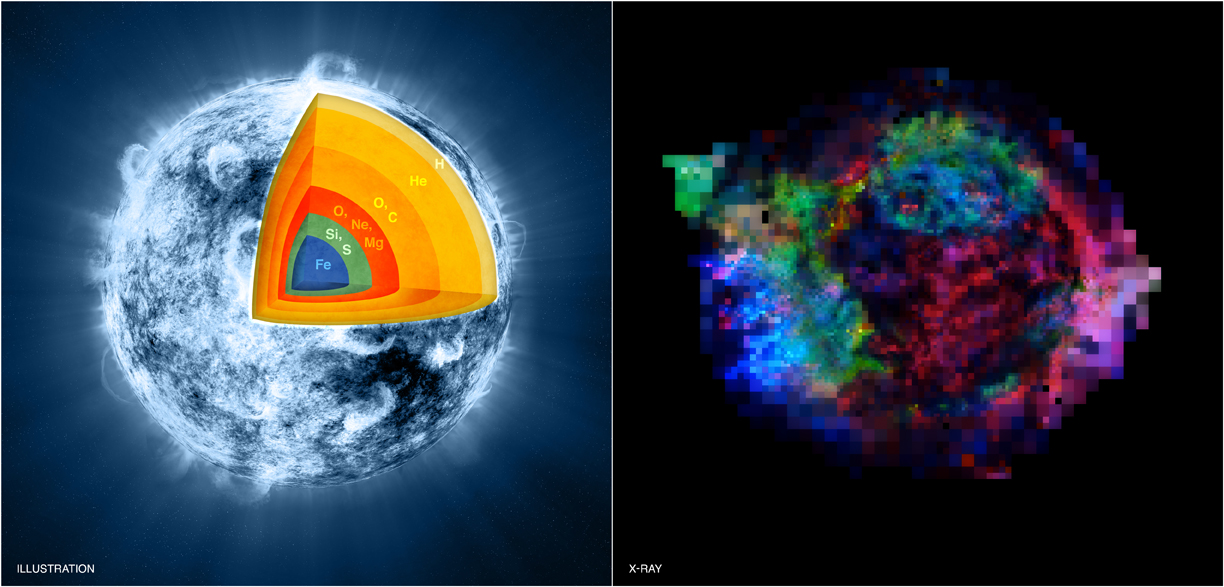
OK: as the star ages, the core becomes choked with a given element. Fusion tapers off, gravity yells, “George!” and hugs and squeezes harder, raising the temperature. Another, heavier element is fused. The lighter elements drift up, away from the core, and if hot enough, fusion can take place at the layer boundaries. In time, the star becomes layered like an onion with different elements. See the image above (click for a larger picture)
Betelgeuse will eventually reach the point where the core is choked with iron. Fusion tapers off and gravity pulls more material into the center. The star is now dying. Once the core reaches about 1.4-1.8** times the mass of our Sun, that’s the straw that breaks the back: Betelgeuse kills itself. The core collapses into a ball of neutrons. Zillions and zillions and zillions of neutrinos are released.
With nothing to hold up the outer layers, gravity happily screams, “GEORGE!” and reaches out in a final loving hug and squeeze. He yanks the outer layers toward the core so hard, they’re traveling as fast as 23% of the speed of light(!!) when they get there … and meet that outward-bound “wall cloud” of neutrinos.
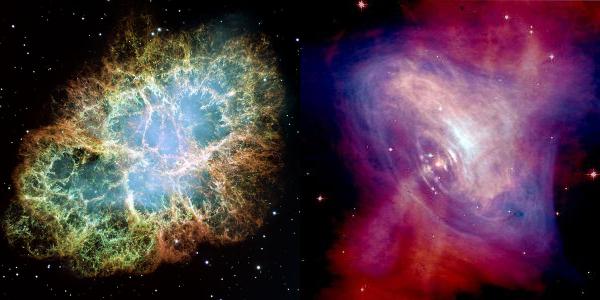
The same Weak Force that worked in the Big Bang to give us the right mix of protons and neutrons also governs this. The whole calamity is “fine tuned” to create and then push these fresh-baked heavy elements into the Cosmos. All that’s left behind is a spinning remnant neutron core (a pulsar) and a faint, distraught voice: “George …”
Setting The Stage
By 9-10 billion years after the Big Bang, the Interstellar Medium has been enriched with heavier elements. We have iron, silicon, oxygen, carbon and stinky sulfur, ready to form planets and people who can argue that it all Just Happened and No Big Deal.
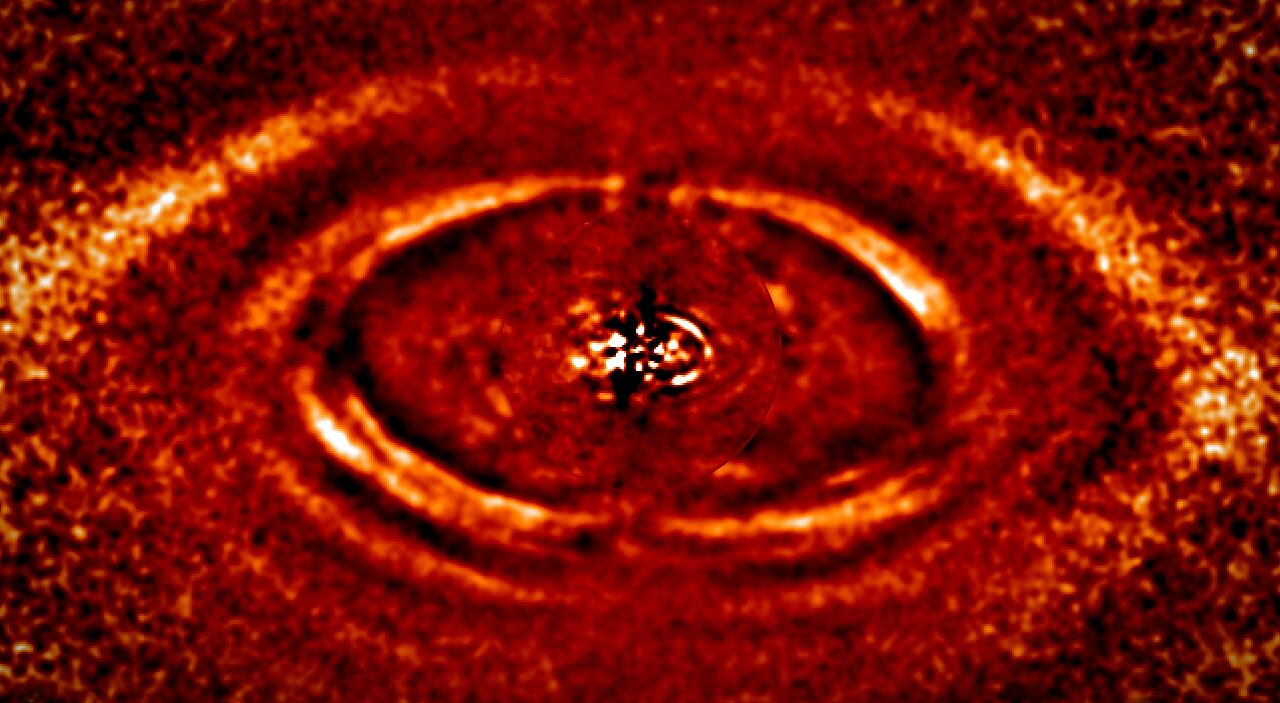
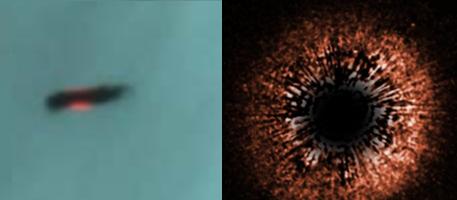
From time to time, a spinning cloud of this rich dust will form a protoplanetary disk. One or more stars will be born in the center, while the circling cloud of dust “clumps” into planets.
Better telescopes have allowed us to directly eyeball how planets might form. Have a look at the images below. The one on the left is from the Orion Nebula, 1000-1300 light years away. The other is around the star designated HD 107146, 88 light years from Earth.
This is another case of, “we know more now …” and we’re going to cover that next.
Use the menu or proceed to the next page, “A Home For Life.”
*A warning for tender hearts and sensitive ears: don’t go searching for “Cannibal Corpse” on YouTube. Your eyes will start smoking and your hair will fall out.
** A picky point: the “classic” Chandrasekhar limit is defined as 1.44 times the mass of our Sun, but this varies in practice. For example, if the star is rotating very quickly, this relieves some of the pressure on the core.